9. Generalizations of the results for broader classes of proper parametral matrices
Our next purpose is to generalize Algorithm 6.1 to arbitrary proper parametral matrices and develop algorithmic procedures for finding the threshold number  of a proper parametral matrix. In view of the definition of almost copositive matrices, is the smallest such value, for which none of the principal submatrices of A(h) is almost copositive. This fact suggests the following scheme as an algorithm skeleton (Algorithm 9.1).
Denote by  the principal submatrices of A(h) in a nondecreasing order of their size; i.e. the first r such submatrices
  are of order 1, while the last such submatrix
  is identical to A(h). The sequential order of submatrices of same algebraic order is optional.
Algorithm 9.1. (placed separately)
This formulation of the algorithm does not contain a copositivity test. It will be built into the algorithm after the proof of this simpler algorithm version, which can be done with the help of the following definition and lemma.
Definition 9.2 Let A denote a real symmetric  matrix, and
  denote the ordered set of all principal submatrices of A in a nondecreasing order of their size. Then A is defined to be b-copositive of order t, if all of
 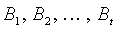 are CP.
Clearly, A is 1CP if and only if A is b-copositive of order r, A is 2CP if and only if A is b-copositive of order  , etc.
Lemma 9.3. If A(h) is a proper parametral matrix,  is a real number such that
  is b-copositive of order t - 1, but not of order t, where
  , and
, and

is finite, then  is b-copositive of order t.
Proof. The copositivity of  follows from feature (iii) of proper parametral matrices (Definition 4.1), while the copositivity of
  follows from the definition of
  .
.
Proof of Algorithm 9.1. If the set, appearing at Step B2 is empty, then clearly A(h) is NCP for any real h. Now let us suppose, that the algorithm ends with a normal termination.  is CP according to the definition of
  contained in step B3 of the algorithm. Applying the assertion of Lemma 9.3, it follows by induction, that
  is b-copositive of order t if
  . For t = N this means that
  is CP. Because
  is NCP, there should be a
  , for which
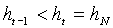 .
.
Then  is NCP for any
  , and consequently so is A(h). We have seen; however, that is CP, thus
  is equal to the threshold number of copositivity of A(h).
Now we are going to reformulate our general algorithm and build a copositivity test into it. Before doing that, we state two more lemmas.
Lemma 9.4. If A(h) is a proper parametral matrix, then
(9.1) 
is convex (i.e. it is either finite or infinite interval).
Proof. Let us consider the sets
(9.2) 
and
(9.3)  .
.
By the definition of almost copositive matrices,
(9.4) 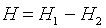 .
.
Obviously  and
and  are intervals on the real axis, both of them being infinite from right. From this it follows that H is also an interval.
Lemma 9.5. Let us suppose that for a proper parametral matrix A(h), the set specified in (9.1) as set H is not empty, and  has a finite value. Then has the following two features:
 ,
,
(9.5) 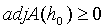 .
.
Proof. Denote by  an arbitrary element of H. According to Lemma 9.4, A(h) is almost copositive for
  ; therefore, according to Theorem 7.8, |A(h)| < 0 and
  are also satisfied if . From this it follows by continuity that the second line of (9.5) is true and
(9.6)  .
.
If  , then A(h) is obviously (r-1)CP, but not almost copositive, so it must be CP. Then is also CP, and therefore
  is not possible, according to Theorem 7.8, i.e. the first line of (9.5) holds as well.
By the help of Theorem 7.8 and Lemma 9.5 we can adjust the general Algorithm 9.1 into the following form (where a copositivity test is already built into the algorithm):
Algorithm 9.6. (placed separately)
In the next part of this section we turn our attention to two special cases, when 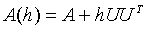 or
or 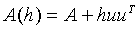 . In the first, more general case let
  denote the submatrix of U consisting of all such row vectors of U, which correspond to a given submatrix
  of A. With this notation
(9.7)  ,
,
and Steps B2-B3 of Algorithm 9.6 require the solution of the equation
(9.8) 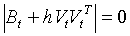 .
.
This is an algebraic equation of order not greater than the rank of . If is invertible, then - according to Theorem 3.9 - (9.8) is equivalent to
(9.9) 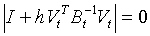 ,
,
i.e. (9.8) leads to seek the eigenvalues of  . We shall prove the following assertion:
Theorem 9.7. Suppose, that A is a real symmetric  matrix, U is a real
  matrix, and let . Further, suppose, that
  is almost copositive for some
  . Denote by H the set
(9.10)  ,
,
and by E the spectrum of 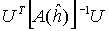 ,i.e.
,i.e.
(9.11)  .
.
Then we state the following:
infH is finite if and only if there exists a  such that l < 0, and then
(9.12)  .
.
Proof will be given by referring to the following lemma.
Lemma 9.8. With the assumption of Theorem 9.7, we state that |A(h)| = 0 if and only if  and
and  .
.
Proof. is invertible according to Theorem 7.8. Therefore Theorem 3.9 can be applied in the following way:
 .
.
From this it follows that|A(h)| = 0 if and only if  , and
, and
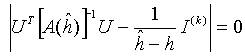
Proof of Theorem 9.7. The value of infH is finite if and only if H is nonempty. According to Lemma 9.8, H is nonempty if and only if  for some
  , i.e. if E contains one or more negative elements. The roots of equation |A(h)| = 0 are the elements of the set

from which follows the validity of (9.12).
Now we are ready to concretize Algorithm 9.6 for the special case where 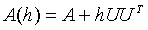 .
.
Algorithm 9.9. (placed separately)
Now let us consider the more special case where 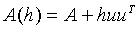 . In this case |A(h)| = 0 is a linear equation, the solution of which can be given explicitely by the help of Corollary 3.5. Moreover, in this case the set E introduced in (9.11) has a single element, namely
(9.13) 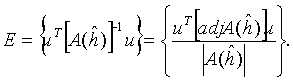
These observations make it possible, that Steps B2 and B3 of the algorithm become much simpler. We shall choose; however, a different approach, and apply the following assertion.
Lemma 9.10. Consider the proper parametral matrix , and suppose that  is almost copositive for some
  . Then we state the following:
a) |A(h)| = 0 if and only if
(9.14) 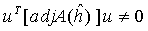
and
(9.15) 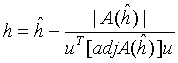 .
.
b) Let  be an arbitrary real number. Then |A(h)| = 0 if and only if
(9.16) 
and
(9.17) 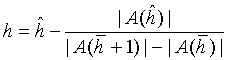 .
.
c) For the solution of|A(h)| = 0,  if and only if
(9.18)  .
.
d) If (9.18) holds, then denoting by  the value obtained according to the right hand side expression of (9.15), and by
  an arbitrary nonzero column vector of
  , the following are true:
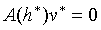 ,
,  , and
, and  .
.
Proof. By applying Corollary 3.5 we get
(9.19)  ,
,
where
(9.20) 
according to Theorem 7.8. This implies assertion a).
From (9.19) it follows that
(9.21) 
which validates assertion b). Assertion c) follows from (9.17) and (9.20).
To prove assertion d), using the matrix identity
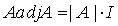 ,
,
and applying Lemma 9.5, one can take the conclusion that 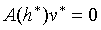 and
and  . Clearly, (9.21) remains true when we substitute
  by an arbitrary real number. Thus
 .
.
From this it follows that 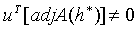 . Because the rank of the adjoint of a singular matrix cannot be greater than 1,
  would imply that
 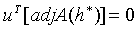 . As this is not the case, consequently is true.
Finally we remark that the difference of two determinants standing on the left of (9.21) is generally easier to handle than a quadratic form like the expression of the right hand side of (9.21).
The assertions stated in Lemma 9.10 can be used for the adaptation of Algorithm 9.6 to the case :
Algorithm 9.11. (placed separately)