 matrix, having the properties, we specify in the following definition.
4. Domain of copositivity of a parametral matrix
For the discussion of this section A(h) will denote a real parametral matrix, having the properties, we specify in the following definition.
Definition 4.1. A real parametral  matrix is proper parametral matrix, if it has the following features:
(i) A(h) is symmetric for every real h.
(ii) A(h) is a continuous function of h.
(iii) For any principal submatrix B(h) of A(h) it is true that if  is CP and
  , then
  is also CP.
(iv) There exists some  such that A(h) is NCP.
The next statement contains examples for proper parametral matrices.
Statement 4.2. If A is a real symmetric matrix and U is a real nonzero  matrix, then
  is a proper parametral matrix. As a special case, for a nonzero r-vector u,
 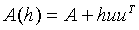 is a proper parametral matrix.
Proof. The validity of (i) and (ii) is obvious. If , then 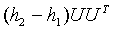 is positive semidefinite, therefore its principal submatrices are all CP. The sum of two CP matrices is also CP. This way, feature (iii) is established.
For the proof of feature (iv) it is enough to show that h may assume such values, for which A(h) has a negative entry in its main diagonal. Indeed, let  be a nonzero row vector of U, then
  holds for any such h for which
  .
.
Definition 4.3. The domain of copositivity of a proper parametral matrix A(h) is the set
(4.1)  .
.
Definition 4.4. The threshold number of copositivity (briefly threshold) of a proper parametral matrix A(h) is the number
(4.2)  .
.
Remark 4.5. Because of the assumption involved in feature (iv) of Definition 4.1, only the following two possibilities may occur:
a) G is empty, and then  ;
;
b) G is nonempty closed convex set, and then  is finite. Further, in this case
 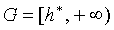 .
.